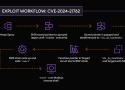
Early this February, Fortinet released an advisory for an "out-of-bounds write vulnerability" that could lead to remote code execution. The issue affected the SSL VPN component of their FortiGate network appliance and was potentially already being exploited in the wild. In this post we detail the steps we took to identify the patched vulnerability and produce a working exploit.
Learn how NetSPI discovered that Microsoft Outlook was vulnerable to authenticated remote code execution (RCE) via synced form objects.

Multiple publicly available exploits have since been published for the critical flaw

Summary Chaining of three vulnerabilities allows unauthenticated attackers to execute arbitrary command with root privileges on Zyxel VPN firewall (VPN50, VPN100, VPN300, VPN500, VPN1000). Due to recent attack surface changes in Zyxel, the chain described below broke and become unusable – we have decided to disclose this even though it is no longer exploitable. Credit … SSD Advisory – Zyxel VPN Series Pre-auth Remote Command Execution Read More »

If you're still running a vulnerable instance then 'assume a breach'

cpe:2.3:a:juniper:jweb:*:*:*:*:*:*:*:*.
Ivanti fixed a critical remote code execution (RCE) vulnerability in its Endpoint Management software (EPM) that can let unauthenticated attackers hijack enrolled devices or the core server.

Learn about a RCE vulnerability, discovered by the Imperva Red Team, identified as CVE-2023-22524, in Atlassian Companion for macOS.

Hackers are attempting to leverage a recently fixed critical vulnerability (CVE-2023-50164) in Apache Struts that leads to remote code execution, in attacks that rely on publicly available proof-of-concept exploit code.

Sophos was forced to backport a security update for CVE-2022-3236 for end-of-life (EOL) firewall firmware versions after discovering hackers actively exploiting the flaw in attacks.

A critical severity vulnerability in a WordPress plugin with more than 90,000 installs can let attackers gain remote code execution to fully compromise vulnerable websites.

Atlassian has released software fixes to address four critical flaws in its software that could lead to remote code execution.

Microsoft Exchange is impacted by four zero-day vulnerabilities that attackers can exploit remotely to execute arbitrary code or disclose sensitive information on affected installations.
(0Day) Microsoft Exchange ChainedSerializationBinder Deserialization of Untrusted Data Remote Code Execution Vulnerability

CVE-2023-45498/CVE-2023-45499 advisory
SolarWinds' access controls contain five high and three critical-severity security vulnerabilities that need to be patched yesterday.

Remote code execution requiring no authentication fixed. 2 other RCEs remain unpatched.

Akamai researchers discover a critical vulnerability in Kubernetes that can lead to remote code execution.

As part of our Continuous Automated Red Teaming and Attack Surface Management technology - the watchTowr Platform - we're incredibly proud of our ability to discover nested, exploitable vulnerabilities across huge attack surfaces.
Through our rapid PoC process, we enable our clients to understand if they are vulnerable to emerging
second part in a two-part series going over heap overflow in MiniDLNA (CVE-2023-33476). this post provides a walkthrough of steps taken to write an exploit for this vulnerability in order to achieve remote code execution and pop a shell.


